

Why MAZZEL’s “The Voice” Left a Lasting Impression
A performance that speaks for itself — and reveals something more when you return to it

The performance video for MAZZEL’s “The Voice” arrived just a day before the start of their first arena tour.
The song stood out as one of the strongest among the newly introduced tracks on their second album, so I had been looking forward to seeing how it would be translated into a performance video.
And when I finally watched it, something immediately felt different.
There was something about it that felt powerful, yet different from what they had done before.
Not just in scale or setting, but in the way the performance seemed to hold its own space — almost quietly, without trying to explain itself.
It stayed with me long after it ended.
At the same time, because what they convey through their performance feels so strong and deliberate, I found myself sensing a slight unease — not with the performance itself, but with how it was being framed.
Not a contradiction, but another layer of how this piece can be experienced.
A Song That Was Waiting for “Now”
Interestingly, “The Voice” is not a new song in the usual sense.
It’s a piece that MAZZEL and SKY-HI had been holding onto for nearly two years — something that, at one point, was even considered for release instead of “J.O.K.E.R.” At the time, it was decided that it wasn’t the right moment.
Looking at it now, that judgment feels exactly right.
Because this version of MAZZEL — releasing their second album and standing on the edge of their first arena tour — feels like the moment this song had been waiting for.
In an interview, RAN described it as a song that “proves MAZZEL is BMSG” — not just in name, but in what they represent.
Watching this performance, that line begins to make sense in a way that goes beyond explanation — not as a concept, but as something you can feel.

Returning to Where MAZZEL Began
The location adds another layer.
The video was filmed at the Oya History Museum, a vast underground space carved from stone — often described as something like a “subterranean temple.”
But beyond its visual impact, it carries a more specific meaning, something many MUZE — MAZZEL’s fans — will immediately recognize.
This is where the final stage of Mission×2 took place.
Where ten finalists once stood, performing for their future.
And where, eventually, the eight members of MAZZEL were chosen.
In that sense, this is not just a dramatic setting.
It’s where MAZZEL began.
Seeing them return to that space now — not as contestants, but as artists — gives the performance a quiet sense of continuity.
A Performance That Speaks Without Words
One of the most striking choices in this video is its restraint.
There is no lip-sync.
No attempt to visually explain the song.
Instead, it relies entirely on movement.
And that decision allows something else to come forward.
The performance doesn’t feel like something being presented.
It feels like something unfolding — quietly, but with intention.
There’s a sense of control in how the members move, but it never feels rigid.
If anything, it feels like they’re breathing with the music.
Dancers like TAKUTO, RAN, and SEITO move with a kind of ease that suggests experience settling into the body.
KAIRYU and EIKI, in contrast, bring a sharpness in expression that feels newly defined.
Moments like the mirrored sequence between NAOYA and HAYATO leave a quiet impression — subtle, but difficult to forget.
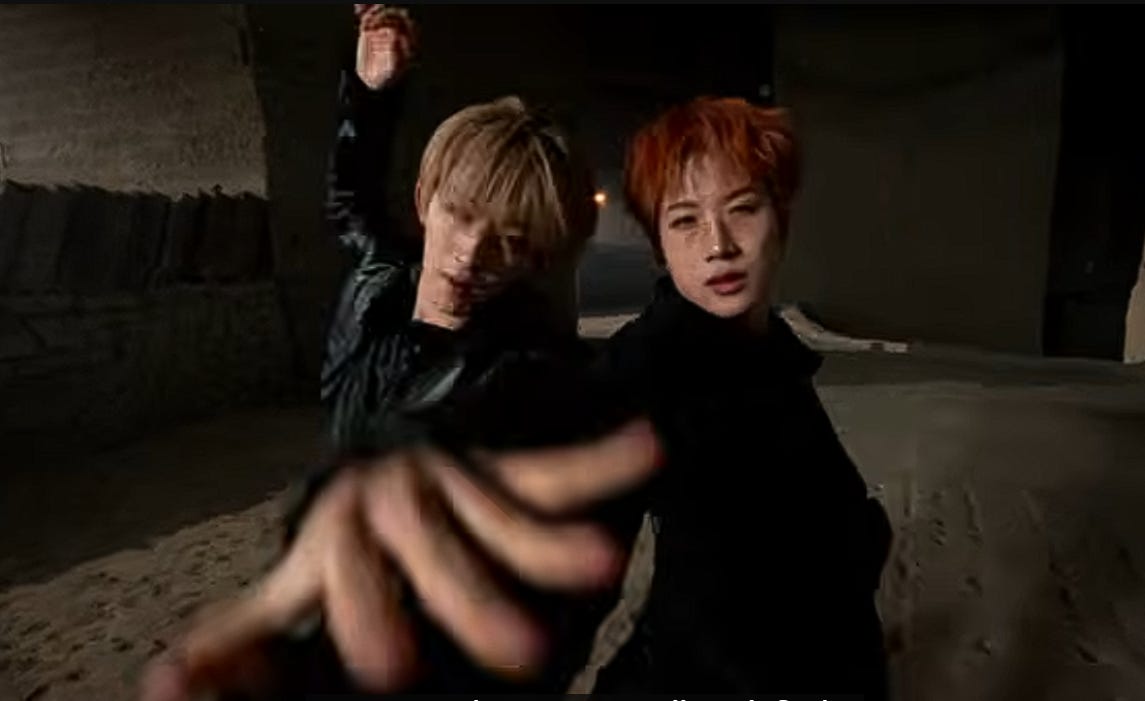
And when RYUKI’s rap comes in, something shifts.
There’s a directness to it — something that cuts through — and suddenly, the performance feels closer, almost confrontational.
The Voice — and What It Holds
The lyrics themselves carry a certain weight.
Questions about how to live, how to love, how to exist — not framed as answers, but as something to sit with.
“The Voice is always mine” repeats throughout the song, like a quiet assertion of ownership.
But in the final moment, that line changes — “The Voice is always yours.”
It’s a small shift, but it lingers.
And in the performance, that shift becomes visible.
Near the end, RAN stands at the center, with the members aligned behind him, almost like an arrow pointing forward.
Then, just as that final line arrives, KAIRYU steps forward from behind him and takes the center to deliver it.
And together, they all point directly toward the camera.
There’s no need to explain it.
But the message lands differently.
Watching It Again
After coming across a different perspective, I found myself returning to the video with a slightly different lens.
It wasn’t something I had questioned at first.
I was simply absorbed by the performance.
But watching it again, I became more aware of how the performance was being framed.
Although presented as a performance video, the camera work often leans toward something more cinematic — closer, at times, to the language of a music video.
It doesn’t just capture the performance.
It interprets it.
That shift doesn’t necessarily change the strength of the performance itself.
But it does change how it is experienced.
And in that sense, it reveals something quietly interesting — not only about the video, but about how we experience performance itself.
Releasing this video on the eve of their first arena tour doesn’t feel accidental.
It feels like a quiet statement of direction.
Not just about where they are now, but about how they intend to move forward.
MAZZEL has always been a group that grows in front of you.
(If you're new to their story, I’ve written more about their unique debut path here.)

And “The Voice” feels like one of those moments where that growth becomes visible in a new way.
Not everything in it is immediately clear.
And maybe that’s why it stays with you.
Written by Lily-K | BMSG Pulse
Thank you for such an interesting perspective on the music video.
You definitely gave me a fresh take on the music video.
I will admit I was too distracted by the camera movements to appreciate and thinking about the small details.
For example, the fact that they did not lip sync was a really interesting creative choice. The song is called The Voice, but they aren't really focusing on voicing it but expressing the voices through movement.
Or the shift in minor word changes in repeated lyrics, which they have also done in Only You and Clover. The changes are subtle, but they delivered it in such a strong way.
I find it really interesting how they chose to have this song end their arena tour shows.