

When “Voice” Becomes Something to Protect
What BMSG’s AI statement reveals about identity — and the role of audiences in shaping it

It’s not unusual anymore to see artists pushing back against AI.
Still, something about the news I came across about Taylor Swift filing to trademark her own voice felt like a shift. Not just legally, but conceptually. A voice doesn’t feel like just a tool for expression anymore. It feels closer to identity.
That idea — voice as identity — was what made me pause.
It reminded me of a statement BMSG released earlier this year.
Full statement available (in Japanese) on BMSG’s official site.
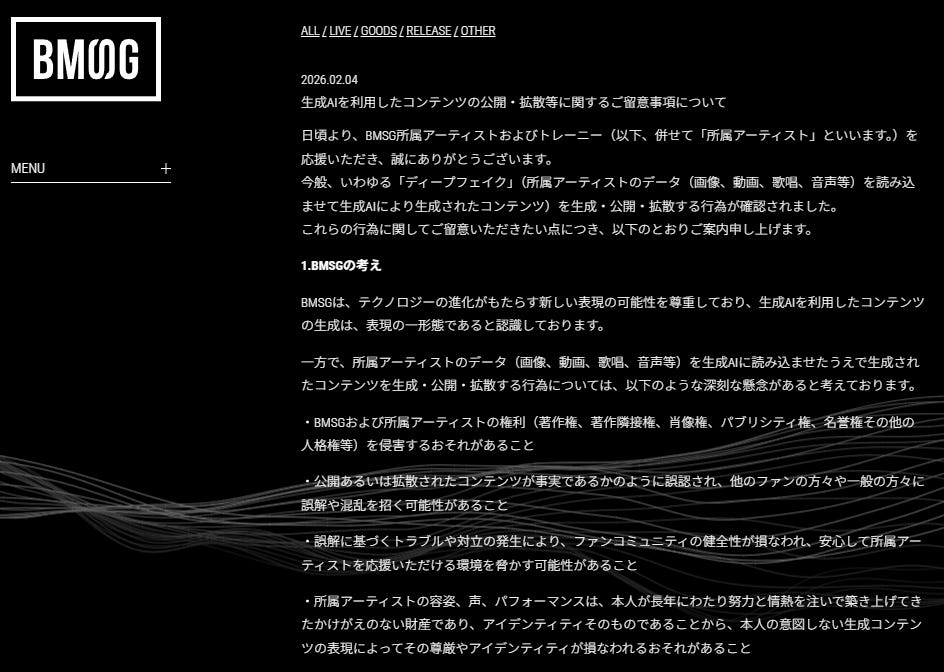
Important Notes Regarding the Publication and Dissemination of Content Generated Using AI
When “voice” starts to feel like identity
One line in the statement had stayed with me. I found myself going back to read it again.
It read:
An artist’s appearance, voice, and performance are built through years of effort, something irreplaceable and inseparable from who they are.
Among otherwise familiar statements, this line stood out. The phrasing felt different.
It also reminded me of something BMSG has often emphasized: “Don’t Kill Talent,” the idea of allowing talent to exist as it is.
(I’ve written more about that idea here.)

And maybe at its core, it suggests something quieter: a sense that what makes an artist who they are calls for a certain kind of respect.
In many cases, conversations about AI and artists tend to focus on rights: what is allowed, what isn’t, and where legal lines should be drawn.
BMSG didn’t ignore those concerns, but this line shifted the emphasis.
It wasn’t only about ownership. It was about identity.
And once I started to see it that way, the issue didn’t feel like just a technical or legal problem anymore. It started to feel more personal — something that affects how an artist exists, not just how their work is used.
Maybe that’s where things are starting to change.
When the boundary becomes less clear
It’s no longer only about what is officially released and what isn’t. The line between original and generated — between intention and imitation — doesn’t feel as clear as it used to.
And that shift doesn’t stay within the artist. It also affects how their work is seen, shared, and even recreated.
As listeners, viewers, and fans, we are no longer just receiving what artists put out into the world. In many ways, we’re already shaping that world.
(I’ve also written about how this sense of individuality shows up in their performances.)

Sometimes that participation is visible through edits, reposts, or AI-generated content. Other times, it’s quieter, but no less influential.
This is where BMSG’s statement felt particularly grounded to me.
It didn’t just address the risks of AI-generated content. It also pointed to the environment around the artists, the space that allows them to continue creating and performing as themselves.
Rather than encouraging public callouts or direct confrontation, it suggested something more restrained. When encountering content that crosses that line, to report it through official channels, rather than amplifying it. To avoid unnecessary escalation. To protect not just the artist, but the environment surrounding them.
Looking at it this way, it starts to feel like the focus isn’t just on preventing misuse.
It’s about preserving something more fundamental — an environment where artists can continue to create, perform, and grow without their identity being distorted or taken out of their control.
And if that’s the case, then maintaining that environment may not be something artists can sustain alone.
What used to feel simple — artists creating, and audiences receiving — doesn’t feel as simple anymore.
The structure itself hasn’t disappeared. But sustaining it may now require something more than just appreciation.
Something quieter. Something more deliberate.
And perhaps, something we haven’t fully defined yet.
Written by Lily-K | BMSG Pulse